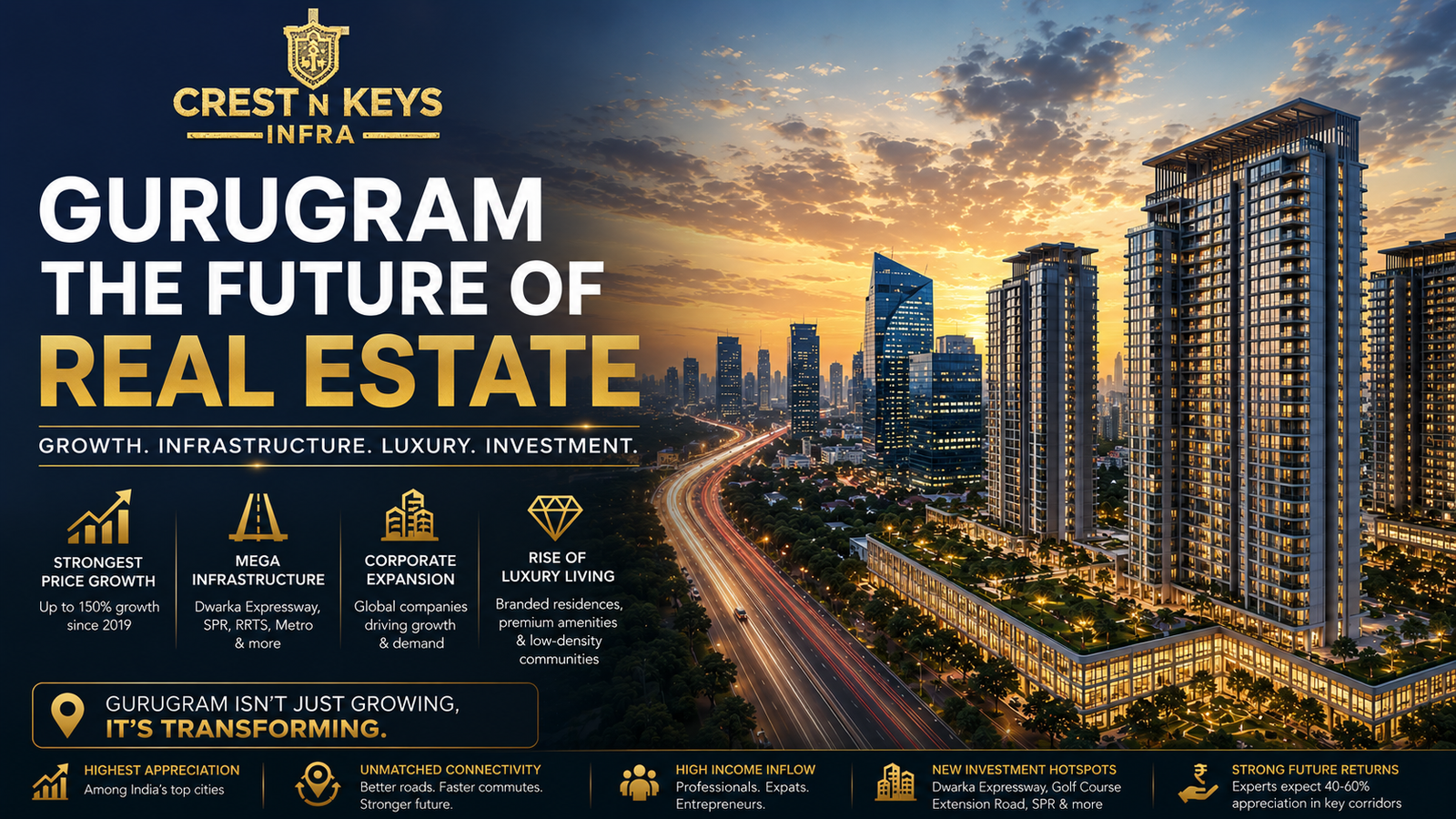
Five years ago, many people still looked at Gurugram as just an office hub beside Delhi. Today, it has become one of India’s strongest luxury and investment-driven real estate markets — and the numbers clearly explain why.
What makes Gurugram different is not just growth. It is the speed, scale, and timing of that growth. Infrastructure, corporate expansion, luxury housing demand, and connectivity are all improving simultaneously, creating one of the strongest real estate cycles NCR has ever seen.
The first major transformation began when multinational companies and IT firms started setting up offices in Cyber City and Golf Course Road.
This phase created:
- high-paying jobs
- migration of professionals
- rising rental demand
- rapid commercial expansion
Developers like DLF shaped Gurugram’s early skyline, and areas like Golf Course Road became premium residential zones. But growth during this period was concentrated mainly around office districts.
The second phase focused on expansion beyond old Gurugram. Key developments included:
- Dwarka Expressway construction
- Southern Peripheral Road (SPR)
- Golf Course Extension Road
- Metro expansion plans
- Improved NH-48 connectivity
This phase opened entirely new investment corridors. At that time, Dwarka Expressway was still considered speculative. Property prices in many sectors remained around ₹6,000–₹9,000 per sq. ft. But investors who entered early during this development stage saw major appreciation later.
This is the phase that completely changed Gurugram’s market positioning. The pandemic changed buyer preferences:
- people wanted larger homes
- premium amenities
- low-density living
- wellness-focused lifestyles
Developers responded with:
- branded residences
- private lift concepts
- rooftop clubs
- wellness zones
- resort-style amenities
This is where Gurugram started competing with global luxury markets instead of just Delhi NCR.
The Numbers Behind Gurugram’s Growth. The strongest proof of Gurugram’s transformation is price appreciation. Dwarka Expressway Appreciation.
According to multiple market reports:
- Average prices on Dwarka Expressway rose from around ₹9,400/sq.ft. in 2020 to nearly ₹18,600/sq.ft. by 2024.
- Some sectors witnessed property values increasing from ₹6,300/sq.ft. to ₹21,000–24,000/sq.ft. in five years.
- 99acres data shows appreciation of over 154% in some Dwarka Expressway segments over recent years.
This kind of growth is not normal urban appreciation. It reflects a market shifting from “developing” to “prime.” Gurugram’s Biggest Growth Drivers.
The biggest reason behind Gurugram’s rise is connectivity. Projects transforming the city:
- Dwarka Expressway
- Delhi–Mumbai Expressway
- RRTS corridor
- Metro expansion
- SPR upgrades
- Elevated road networks
- Travel times across NCR are shrinking dramatically.
This matters because historically: wherever infrastructure improves, property values follow. Experts expect another 40–60% appreciation in key corridors over the next five years because of ongoing infrastructure expansion.
Gurugram continues attracting:
- Fortune 500 companies
- startups
- fintech firms
- global offices
- logistics hubs
This creates a constant inflow of:
- high-income professionals
- expats
- business owners
- More income directly fuels demand for premium housing.
According to market reports, Gurugram accounted for nearly 39% of NCR’s annual warehouse leasing in 2025, showing how rapidly the city’s commercial ecosystem is expanding.
The biggest shift is happening in the luxury segment. Luxury buyers are now choosing:
- low-density residences
- branded projects
- golf-facing homes
- wellness-focused communities
A major example was DLF’s ultra-luxury project “The Dahlias,” where 173 units reportedly generated around $1.4 billion in sales within weeks.
This proves one important thing: high-net-worth buyers are heavily bullish on Gurugram.
Most cities grow in one direction at a time. For example:
- some cities grow commercially
- some grow residentially
- some grow slowly through infrastructure
- infrastructure growth
- luxury demand
- corporate expansion
- investor confidence
- global developer interest
all happening together. That combination creates aggressive appreciation cycles.
The next phase of growth is shifting toward:
- Dwarka Expressway
- Golf Course Extension Road
- SPR corridor
- Sector 63A
- New Gurugram
These corridors are benefiting from:
- improved connectivity
- new luxury launches
- upcoming metro plans
- large-scale township developments
Many of these areas are still mid-development, which is why investors see strong upside potential.
If current trends continue, Gurugram could become:
- NCR’s strongest luxury housing market
- India’s largest branded residence hub
- one of the country’s top commercial ecosystems
Circle rates in some areas have already increased sharply, with certain sectors witnessing hikes up to 75% in recent revisions.
Meanwhile, reports show Gurugram recorded the highest housing price growth among India’s top cities since 2019, with average prices rising nearly 150%. That level of appreciation is extremely difficult to ignore.
Gurugram’s story is no longer about future potential alone. Much of the transformation is already visible. What began as a corporate extension of Delhi has evolved into:
- luxury housing destination
- global business hub
- high-growth infrastructure market
- one of India’s strongest real estate investment zones
The biggest lesson from Gurugram’s journey is simple:
People who invested during the “development phase” benefited the most during the “growth phase.” And many investors believe the city is still entering its next major expansion cycle.