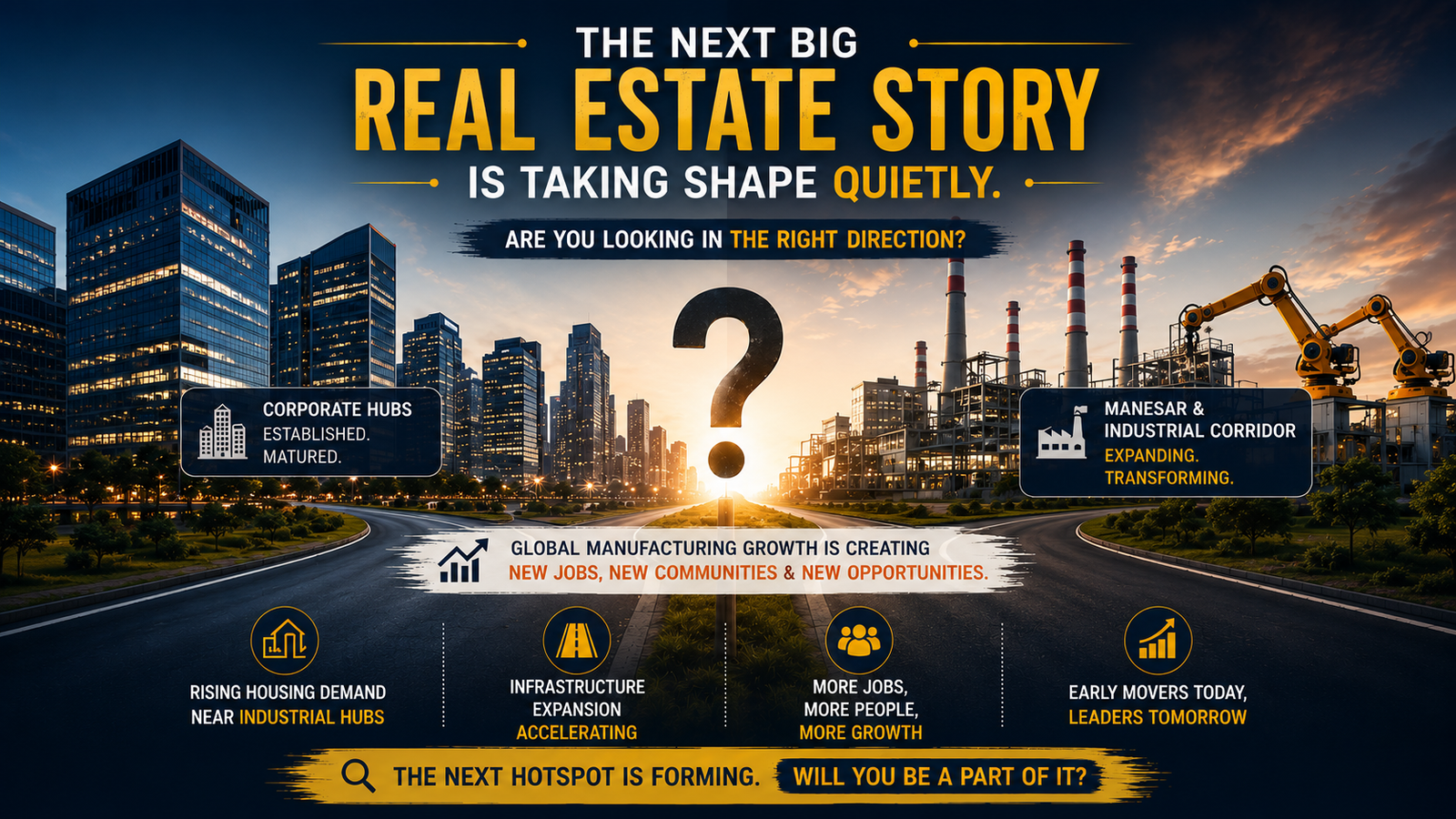
For years, Gurgaon real estate success was closely tied to its booming IT parks, corporate offices, and business districts. Areas surrounding Cyber City, Golf Course Road, and Udyog Vihar became symbols of the city’s economic rise, attracting professionals and investors alike.
However, a new growth engine is quietly reshaping the Gurgaon Real Estate sector. Manufacturing hubs across Manesar, Jhajjar, and the wider industrial belt of Haryana are creating a fresh wave of residential and commercial real estate demand. What was once considered a peripheral industrial zone is now emerging as one of the most promising real estate destinations in the National Capital Region (NCR).
Traditionally, Real Estate, where industrial employment is becoming a major driver of housing residential demand in Gurgaon revolved around office workers seeking homes close to business districts. Today, global manufacturing investments are creating a different housing dynamic. This shift is creating a new chapter for Gurgaon demand.
Haryana has become a preferred destination for international manufacturing companies, particularly from Japan, South Korea, and other industrial economies. Sectors such as automotive, electronics, engineering, and industrial equipment are witnessing significant expansion across the Gurgaon-Manesar corridor. This influx of investment is bringing thousands of engineers, plant managers, technical specialists, and expatriate professionals into the region.
Unlike traditional corporate employees, these professionals prioritize proximity to industrial facilities, shorter commute times, and integrated communities located near manufacturing clusters.
Once known primarily for factories and industrial units, Manesar is rapidly evolving into a sought-after residential market. As industrial activity expands, Gurgaon Real Estate developers are increasingly focusing on projects near manufacturing clusters.
The region benefits from:
- Strong industrial employment generation
- Proximity to major manufacturing facilities
- Excellent connectivity through NH-48
- Access to the Kundli-Manesar-Palwal (KMP) Expressway
- Growing social infrastructure and township developments
establish As more multinational companies operations in the area, demand for quality housing continues to rise. Investors are increasingly viewing Manesar as a long-term growth destination rather than simply an industrial suburb.
One of the strongest indicators of this transformation is the increasing presence of international corporations across Haryana’s manufacturing ecosystem. The growing presence of multinational companies is strengthening the long-term outlook for Gurgaon Real Estate.
The state hosts hundreds of Japanese companies operating across automotive, electronics, and engineering sectors. Major industrial investments continue to flow into the region, creating sustained demand for both ownership housing and rental properties.
This trend is particularly visible among expatriate professionals who seek:
- Serviced apartments
- Premium rental homes
- Gated communities
- Integrated townships
- Managed residential developments
Developers are responding by designing projects that cater specifically to this growing demographic.
The next phase of NCR development is increasingly focused on self-sustained townships rather than standalone residential projects.
Large-scale developments near industrial corridors combine:
- Residential neighborhoods
- Commercial districts
- Educational institutions
- Healthcare facilities
- Retail and entertainment zones
- Green spaces and
- recreational amenities
These developments represent the evolving nature of Gurgaon Real Estate, where integrated living is becoming a preferred choice. This “live-work-connect” model aligns perfectly with the needs of modern professionals working in manufacturing and logistics sectors. As industrial employment expands, integrated townships are expected to become a dominant feature of the Gurgaon-Manesar-Jhajjar corridor.
Real estate growth does not happen in isolation. Infrastructure development is playing a crucial role in unlocking new investment opportunities across Gurgaon’s outskirts.
Key infrastructure drivers include:
- NH-48 connectivity
- KMP Expressway
- Delhi-Mumbai Industrial Corridor influence
- Dwarka Expressway connectivity
- Planned urban infrastructure upgrades
- Improved logistics and freight networks
Improved connectivity continues to unlock new opportunities across the Gurgaon Real Estate market. These projects are making peripheral locations more accessible while enhancing their attractiveness for both businesses and homebuyers.
Why Investors Are Watching the Industrial Belt Closely
The real estate market has historically followed employment generation. Wherever jobs are created, housing demand eventually follows. For investors, Gurgaon Real Estate offers a unique combination of industrial growth and residential demand.
Manufacturing-led growth offers several advantages:
1. Long-Term Economic Stability:
Industrial investments are typically long-term commitments, creating sustained demand for housing and services.
2. Growing Rental Market:
The influx of domestic and international professionals is strengthening rental yields in emerging industrial corridors.
3. Capital Appreciation Potential:
As infrastructure improves and employment hubs expand, property values often experience significant appreciation.
4. Diversified Demand Base:
Unlike purely corporate markets, manufacturing regions attract a mix of workers, executives, expatriates, and support businesses.
These factors make industrial corridors increasingly attractive to both end-users and investors.
Gurgaon’s growth story is no longer limited to Cyber City and traditional corporate districts. The next chapter is unfolding across industrial corridors where manufacturing, infrastructure, and global investment are converging to create new opportunities.
As multinational companies continue expanding operations in Manesar, Jhajjar, and surrounding regions, residential demand is expected to follow. The result is a broader and more diversified real estate market that extends well beyond the city’s established commercial centers.
For homebuyers, investors, and developers, understanding this manufacturing-led transformation may be key to identifying the next wave of growth in NCR real estate.
The rise of global manufacturing in Haryana is reshaping Gurgaon Real Estate, influencing where people live, invest, and build communities. Industrial growth, foreign investment, improved infrastructure, and integrated township development are collectively creating a new real estate map for the region.
While Cyber Hub remains a symbol of Gurgaon’s corporate success, the future may well belong to the industrial corridors that are quietly driving the next phase of urban and economic expansion.
Frequently Asked Questions (FAQs)
Q1. Why is manufacturing becoming important for Gurgaon Real Estate?
Manufacturing investments are creating jobs and increasing housing demand, driving growth beyond traditional corporate hubs.
Q2. Why is Manesar emerging as a real estate hotspot?
Manesar benefits from industrial growth, strong connectivity, infrastructure development, and rising demand for quality housing.
Q3. How do global manufacturing companies impact the property market?
They attract professionals, expatriates, and businesses, increasing demand for residential, rental, and commercial properties.
Q4. What role does infrastructure play in Gurgaon Real Estate growth?
Projects like NH-48, KMP Expressway, and Dwarka Expressway improve connectivity and unlock new investment opportunities.
Q5. Is investing in Gurgaon’s industrial corridors a good option?
Industrial corridors offer strong rental demand, long-term appreciation potential, and diversified real estate opportunities.